I often get asked by young people for advice about getting into journalism – so often that I've written down my top six tips to share! Scroll down for the full list and feel free to pass on.
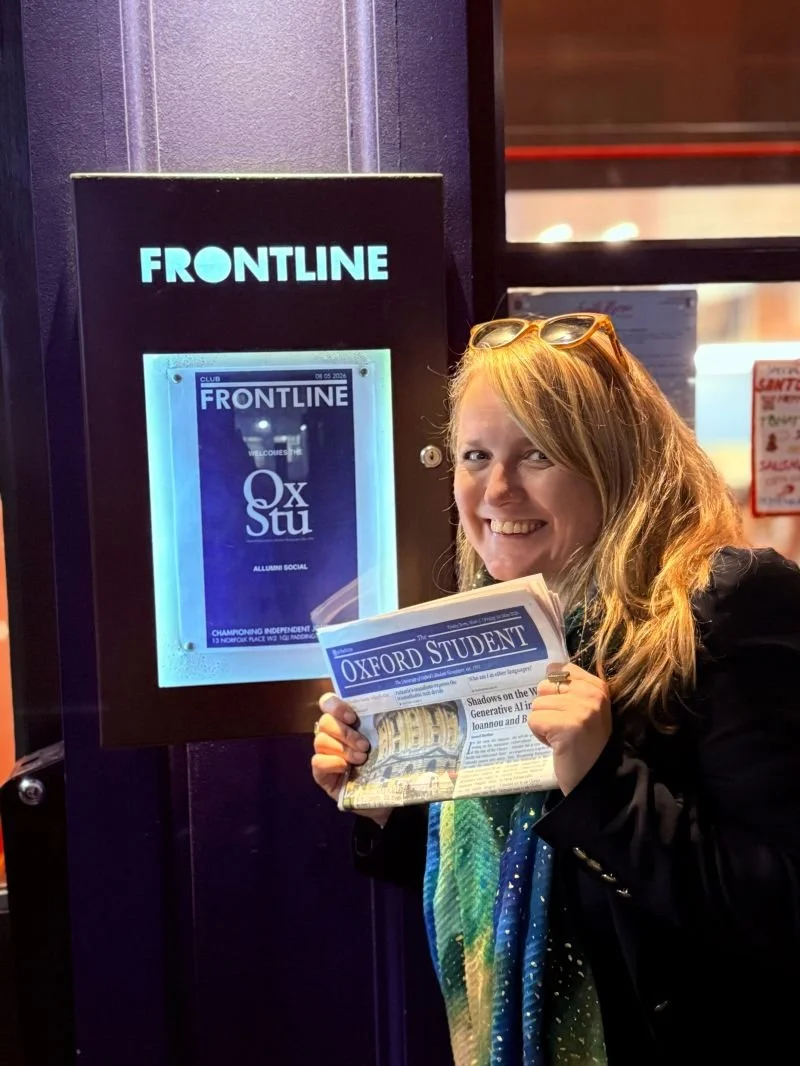
The picture is me with the newspaper I edited as a student, of which I'm now a publisher, outside the legendary Frontline Club where we had reunion drinks earlier this year.
1) Learn about the many different roles in journalism:
People's ambitions often lean toward on-camera roles, including news anchors, and bylined newspaper writers, as those might be the most familiar. But there are a whole host of jobs, including more invisible ones that actually hold a great deal of power! From live gallery producers to newsroom executives and business teams, from social media journalists and SEO specialists to open source investigators, from camera operators to radio and podcast producers, to documentary filmmakers to wire journalists – the list goes on. Take the time to familiarise yourself with the entire landscape, it's much bigger than you might think and there might be interesting opportunities (and more of them) in underexplored areas.
2) Consume everything and deconstruct how professionals do it:
Read, watch, listen – avidly and very widely (and pay for as much as you're able to). Consume media right across the spectrum, from the traditional to the avant garde, and work out how people are executing what you're consuming. I taught myself how to shoot and edit news packages by literally deconstructing what I was watching shot-by-shot: Was it a wide, a medium, a close-up shot? How long did they hold the shot for? How was the script structured? What were they doing with the sound? What did I need to improve in my technique/approach to reach for that professionalism that I was experiencing? The same can be done for almost any report in any format – and can be applied to both the technicalities of production as well as how to be an ethical and factual reporter. Supplement this self-directed deconstruction with drawing on the mulitude of online resources out there, especially from well-known journalism schools and courses.
3) Consider that further study – if it's available to you:
There are incredible courses that teach you the practical and technical skills, and the legal and ethical frameworks you need as a working journalist – BUT they are expensive and not available to everyone. I didn't do any post-graduate study for various reasons – I wanted to get going in my work, I wanted to travel, and it felt like too great a cost. In the UK, two institutions people often gravitate towards for post-graduate programmes are the journalism courses at City University and Cardiff University. There are also shorter NCTJ courses, including remote ones and ones that do not require university degrees, but a significant advantage I've seen of the in-person courses is the industry access and people you meet. The institutions are very well thought of, and media decision-makers often look to recruit from there, as well as give talks and stay connected with students and recent graduates. There are also various apprenticeships and self-directed online courses. Learning is a lifelong exercise, so keep that curiosity alive!
4) Find a niche:
You might find it easier to enter the world of journalism through building on a particular niche. If you're passionate about a particular sport, have fluency in another language, or deeply understand the mechanics of repairing instruments, don't underestimate the potential for these to be professional strengths. I actually got my first ever bylines as a teenager writing regatta reports for local and regional papers, which I came to via my local city rowing club where I rowed and coxed. I wrote these for free, which I could do as a 16/17-year-old with a supportive family, but it was excellent experience and gave me something to show down the line. Unfortunately, there is often a certain element of working for free at the beginning of a journalism career (and not just at the beginning!) – which often isn't fair, nor available to everyone. But working on a student or school newspaper for example can be really good, purposeful fun, with a great sense of community as everyone is working for free, and it is a way of building up a portfolio of work.
5) Get doing:
The rise of social media, along with the ability to shoot and edit high-quality photos and video right on your phone, has made it easier than ever to build skills and demonstrate your commitment to the craft. Try things – be experimental, learn skills from online tutorials (I used a lot when I learned to shoot video!), test them out, and if you're confident, start sharing them too. You might want to start writing lots of book reviews, even if only four people read them initially (and they're all members of your family). But the fact you're doing and making an effort to learn and try will show others how committed you are to developing your skills, as well as giving you a chance to make mistakes and learn things. Be careful not to share inaccurate material or defame anyone in the process! On that note, many resources online cover media law, and it's worth familiarising yourself with the legal landscape.
6) Ask us questions, but carefully:
Take the opportunity to meet as many people as possible and to reach out to people in the industry to ask for advice and build connections. Most of us will try our best to support people interested in working in the media, but be careful how you approach busy professionals. Minimise the burdens on our time – open-ended enquiries can feel frustrating, so try to approach people with a specific question. But make sure it's one that you can't answer yourself with a little online research. And do that research – we'll appreciate it if you've taken the time to read and watch our work. Curiosity and initiative-taking are needed in spades in journalism. Don't be shy but remember that we are busy people! Many aspiring journalists ask directly for work experience – it might be more strategic to ask about the application process at a particular organisation, rather than make an outright request. The industry needs a lot of people to keep it running, so there is space – but be prepared to take on the night shifts and the initially glamour-free tasks and the small freelance asks. Also make sure you communicate to the professionals what YOU can offer us in terms of time and energy, and also skills and expertise, however nascent. Don’t forget the technological savvy you have as Gen Z’s and younger – lean into your digitally native advantages and enhance/offer that edge.
And if all else fails, no harm in having some practical, AI-proof skills in your back pocket for lean times! Plumbing training, anyone?